ASUS vs MSI Laptops: Which Offers Better Value in 2026?
-
June 04 , 2026
-
38
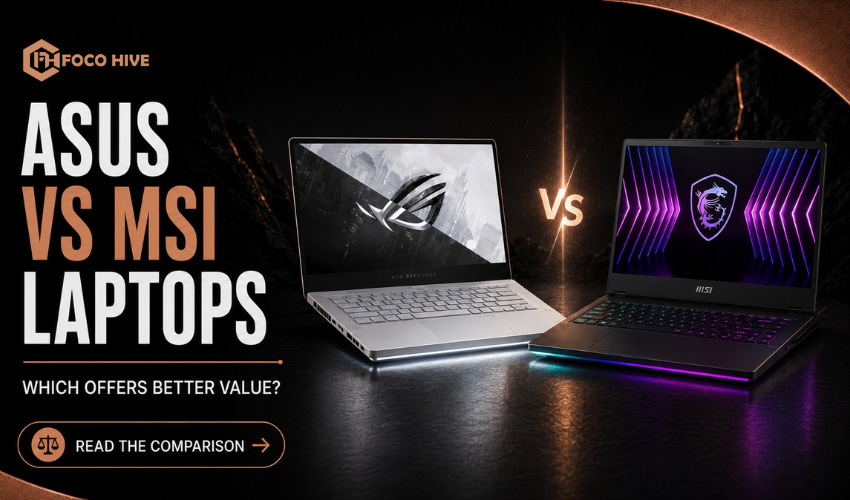
When comparing ASUS and MSI gaming laptops in 2026, the discussion usually comes down to one core question: performance versus overall value. Both brands are strong players in the gaming laptop market, but they take different approaches. ASUS focuses on balanced performance, design variety, and a wide price range. MSI, on the other hand, prioritizes raw gaming power and high-performance hardware.
So the real question is simple: which brand actually gives you better value for your money?
Table of Contents
- Brand Overview
- Performance Comparison
- Cooling & Thermal Design
- Build Quality & Design
- Price & Value for Money
- Popular Laptop Series
- Pros and Cons
- Which Brand Should You Choose?
- Final Verdict
- FAQs
1. Brand Overview
ASUS is known for its diverse gaming lineup. The ROG series targets high-end gaming, TUF focuses on budget-friendly performance, and Zephyrus offers thin and premium gaming laptops. Overall, ASUS emphasizes versatility across different user needs. MSI, in contrast, is more performance-focused. Its Raider series targets high-end gaming, Stealth blends thin design with power, and Katana covers the budget segment. MSI’s core identity revolves around maximizing gaming performance.
2. Performance Comparison
MSI generally delivers stronger raw gaming performance in many comparable price segments. Its laptops are often tuned for higher sustained FPS in demanding AAA games. ASUS provides more balanced performance across its lineup. While ROG Strix models can compete with MSI at the high end, Zephyrus laptops prioritize efficiency and portability rather than maximum power. In simple terms, MSI focuses more on performance-first gaming, while ASUS focuses on balanced usability.
3. Cooling & Thermal Design
Cooling plays a major role in gaming performance. MSI laptops, especially the Raider and Vector series, are designed for long gaming sessions and strong sustained performance. However, they can be louder under heavy load. ASUS uses advanced cooling systems across its ROG lineup. It tends to maintain quieter operation in mid-level usage, while thinner models like Zephyrus prioritize portability over extreme cooling capacity. Overall, MSI often performs better under continuous heavy gaming, while ASUS balances noise, heat, and design more effectively.
4. Build Quality & Design
ASUS laptops generally have a cleaner and more modern design language. The Zephyrus series, in particular, is known for its slim and premium feel. MSI laptops lean toward a more aggressive gaming aesthetic. High-performance models are often bulkier but built to support stronger hardware. In short, ASUS feels more refined and versatile, while MSI feels more performance-oriented.
5. Price & Value for Money
MSI often provides better raw specifications for the price, especially in the mid-range gaming segment. This makes it appealing for users who prioritize FPS and performance over design. ASUS offers a wider pricing structure and stronger ecosystem support, but premium models can be slightly more expensive for similar specifications. From a performance perspective, MSI often delivers higher FPS per dollar, while ASUS provides better balance across different use cases.
6. Popular Laptop Series
ASUS offers the ROG Strix series for high-performance gaming, Zephyrus for thin and premium laptops, and TUF for budget gaming. MSI provides the Raider series for flagship performance, Stealth for thin gaming and creator use, and Katana for budget-friendly gaming. Both brands cover similar categories, but ASUS leans more toward hybrid usability, while MSI stays focused on gaming performance.
7. Pros and Cons
| ASUS PROS | ASUS CONS |
| Strong balance of performance and design | Some models prioritize aesthetics over maximum performance |
| Better portability in many laptop series | Performance can vary significantly across product lines |
| Wide range of options across different budgets | Certain premium models can be expensive for the specifications offered |
| Attractive and modern laptop designs | Software experience may include unnecessary pre-installed applications |
| Suitable for students, professionals and gamers alike | Build quality can differ between budget and premium models |
| MSI PROS | MSI CONS |
| Excellent gaming performance for the price | Designs are often bulkier and less portable |
| Strong cooling systems, especially in high-end models | Budget models may feel less refined in build quality |
| High-refresh-rate displays available across many gaming laptops | Battery life is often weaker than productivity-focused competitors |
| Good value for gamers seeking maximum hardware power | Gaming-focused aesthetics may not appeal to all users |
| Wide selection of gaming-oriented configurations | Fan noise can be noticeable under heavy workloads |
8. Which Brand Should You Choose?
ASUS is the better choice if you want a balanced laptop for both gaming and productivity, care about design and portability, or want a wider selection of models. MSI is the better choice if your priority is maximum gaming performance, you play demanding games for long sessions, and you don’t mind a heavier design.
9. Final Verdict
There is no absolute winner between ASUS and MSI in 2026 because they target different types of users. MSI wins in raw gaming performance and value per frame. ASUS wins in overall balance, design flexibility, and versatility. The simple takeaway is this: if you want pure gaming performance for your money, MSI is stronger. If you want an all-round laptop for gaming and everyday use, ASUS is the better choice.
10. FAQs
Is MSI better than ASUS for gaming?
MSI often delivers better raw performance in similar price ranges.
Are ASUS laptops more reliable?
ASUS is generally more consistent across its product lineup.
Which is better for students?
ASUS, due to better portability and balanced designs.
Which brand has better cooling?
MSI often performs better in sustained heavy gaming.
Which offers better value?
MSI is better for performance value, while ASUS is better for overall versatility.
Can I write you?
Sign up to get my weekly newsletter.